William Friedkin may be the only working filmmaker still capable of giving me the heebie-jeebies. I’m told his mid-80s-to-early-00s output has been spotty, but it seems he’s found a muse in the Steppenwolf Theatre’s Tracy Letts. They first joined forces on 2007’s Bug, a pressure-cooker by virtue of its central folie à deux alone, to say nothing of its single-room setting and breathlessly manic monologuing. With Killer Joe, they recapture much of the same visceral, unrelenting energy for a story that wouldn’t necessarily promise it, of life insurance fraud gone horribly, unavoidably awry . Like Bug, Killer Joe is Southern-fried noir structured by a series of verbal standoffs alternately seething and shrill but always enthralling. The Dallas trailer-trash cast’s attempts to outsmart one another proceed on the shaky premise that there’s any intelligence present to thwart. The lone exception is the eponymous avocational hitman, played with such easy menace by Matthew McConaughey that you wonder if the role, written when he was only just thinking it'd be a lot cooler if you did have a joint, was somehow conceived with him in mind. Thomas Hayden Church also stands out as the slack-jawed patriarch whose deadpan delivery gets the lion’s share of the film’s laughs. But here I am talking about performances when all you want to know is whether and how it earns its NC-17, that great slayer of box office prospects. The answer to the first part is both yes and no. Yes, it is a nasty, violent piece of work, but not significantly more so than anything else Friedkin has done – certainly not Bug, with its tooth extractions and graphic Foley art thereof. Sex was clearly the tipping point: Gina Gershon is preceded by her merkin in her first scene, and forced to perform fellatio on fried chicken with a broken nose in her last. I’m all for according sexual violence the most restrictive of ratings, and besides, I’m certainly no Puritan, but I must echo Roger Ebert’s thoughts from his (positive) review of the film: if anything can earn this dubious honor, shouldn’t violence alone? Absent a sufficiently coherent Other against which to classify itself, as pornography provides film vis-à-vis lusty bodies, it likely never will. All the squirmy moralist deep inside me is left to do is throw his hands high, resigned, sigh, and surrender to Friedkin's resolutely amoral, skin-crawling thrills. I can think of worse fates.
Sunday, March 3, 2013
KILLER JOE
William Friedkin may be the only working filmmaker still capable of giving me the heebie-jeebies. I’m told his mid-80s-to-early-00s output has been spotty, but it seems he’s found a muse in the Steppenwolf Theatre’s Tracy Letts. They first joined forces on 2007’s Bug, a pressure-cooker by virtue of its central folie à deux alone, to say nothing of its single-room setting and breathlessly manic monologuing. With Killer Joe, they recapture much of the same visceral, unrelenting energy for a story that wouldn’t necessarily promise it, of life insurance fraud gone horribly, unavoidably awry . Like Bug, Killer Joe is Southern-fried noir structured by a series of verbal standoffs alternately seething and shrill but always enthralling. The Dallas trailer-trash cast’s attempts to outsmart one another proceed on the shaky premise that there’s any intelligence present to thwart. The lone exception is the eponymous avocational hitman, played with such easy menace by Matthew McConaughey that you wonder if the role, written when he was only just thinking it'd be a lot cooler if you did have a joint, was somehow conceived with him in mind. Thomas Hayden Church also stands out as the slack-jawed patriarch whose deadpan delivery gets the lion’s share of the film’s laughs. But here I am talking about performances when all you want to know is whether and how it earns its NC-17, that great slayer of box office prospects. The answer to the first part is both yes and no. Yes, it is a nasty, violent piece of work, but not significantly more so than anything else Friedkin has done – certainly not Bug, with its tooth extractions and graphic Foley art thereof. Sex was clearly the tipping point: Gina Gershon is preceded by her merkin in her first scene, and forced to perform fellatio on fried chicken with a broken nose in her last. I’m all for according sexual violence the most restrictive of ratings, and besides, I’m certainly no Puritan, but I must echo Roger Ebert’s thoughts from his (positive) review of the film: if anything can earn this dubious honor, shouldn’t violence alone? Absent a sufficiently coherent Other against which to classify itself, as pornography provides film vis-à-vis lusty bodies, it likely never will. All the squirmy moralist deep inside me is left to do is throw his hands high, resigned, sigh, and surrender to Friedkin's resolutely amoral, skin-crawling thrills. I can think of worse fates.
Wednesday, February 27, 2013
SKYFALL and the Pleasure of Pedigreed Sexism
Do we ever need a caveat emptor for a Bond film’s mean-spirited sexism? Mais non, fans of the latest cry, it’s just a bloody Bond film! And so it is, meeting its duties with the canny panache of a first-rate ad agency. The timeworn brand iconography is present and accounted for: the man, the music, the martini; exotic locales, improbable stunts, nefarious villainy. But of course they are. What really gives 007’s 23rd (in year 50) the market advantage is director Sam Mendes’ art film polish. Or rather, cinematographer Roger Deakin’s, a Coen brothers favorite: from a birds-eye-view of a train in Turkey to the depths of a frozen lake in Scotland, this is one good-looking movie, owing no small due to the countless, nameless set designers, costumers and lighting technicians at hand (although the shadowcast fisticuffs in Shanghai I’m willing to credit entirely to the cameraman’s genius). It is also about as middlebrow as they come, which is to say, as lower-middle aspiring to high. Consider how M reads Tennyson during a cross-cut crosstown chase. Or how megalomaniac Silva’s interrogation room shamelessly apes Hannibal Lecter’s. Or how Silva, Bond, and M are triangulated into a Freudian standoff for Mommy’s love. (Is it an accident that when pronouncing M’s name, Bond stretches it to sound like ‘mum’? You tell me.) Openly gay screenwriter John Logan has curried much favor for writing Silva as a complex gay villain, meaning that a preening homo scarred by maternal neglect is ‘complex’; who knew?
This
is not to say Skyfall isn’t all
admirably well-played, -written, -delivered, and so on and so forth: it’s as
tailored to prevalent concepts of quality as Tom Ford’s suit is to Daniel
Craig’s sinewy body. But what are we
supposed to do with the fate of Berenice Marlohe’s bodacious Severine, righteously
called out by London Times critic Giles Coren in a banned editorial? Her cavalier treatment would cast a pall over any film,
but in the context of a PG-13 prestige blockbuster peddling a nostalgia that
culminates in men’s restoration to their rightful sovereignty – Ralph Fiennes
takes Dame Judi Dench’s place when M expires; Naomi Harris’s Moneypenny relinquishes
her rifle and happily takes a desk job after Bond suggests “field work isn’t
for everyone” – Severine’s victimization is the nasty apex of a thoroughly
reactionary two-and-a-half hours at the movies.
What seems cause for concern, I think, is how little concern this has caused. Many hands have wrung this week in the wake of Seth MacFarlane’s boorish hatchet job hosting the Oscars, and rightly so, but a curious blind spot persists in the riled blogosphere, epitomized by the New Yorker’s Amy Davidson: “it’s notable that two of the better moments in the show involved Bond films.” It is notable. Davidson refers to Shirley Bassey’s performance of “Goldfinger” and Adele’s of “Skyfall,” which partitioned a midshow retrospective of the Bond franchise, and she’s right: here are instances of abundant dignity for women onstage, neither of them conforming to the standards of beauty snidely upheld by the host, the red carpet, and the culture industry writ large. But how do we cope with this dignity’s enlistment in honoring cinema’s most evergreen icon of alpha masculinity?
We
don’t, fans of the series reply, it’s just a bloody fantasy. And so it is, but that fantasy doesn’t
consist only in Bond’s amply bestrewn gentility. It consists also in the social relations that
gentility preserves. There’s the
Eurocentrism, of course, and there’s the upper-snuff pedigree; he never reads but we must assume he's an Oxonian. And then there’s the sexism. The Bond girls - all fully grown women, I seem to recall - and their habitual
undress; his burning through them; his occasional corporal discipline when they
get out of line. The slapping has
generally ceased by now, but Bond’s rough way with Séverine in Skyfall is one (uncomfortable) nod to Bond’s legacy (From Russia With Love in particular, winked at also by that aforementioned Turkish train) in a film that boasts many. I would buy the disavowal - that we know it's all imaginary, thank you very much - if the legions who saw it seemed to value some kind of critical distance, but
that’s clearly not the case. On the
contrary, the positive critical consensus has overwhelmingly valued the poetic realism, the
unmannered acting, and the thematic nuance of Mendes’ film: in short, the capacity
to get swept up in it in spite of it all. (I am not innocent of this: although I resisted Skyfall, I remain a fan of Casino Royale, the first Bond with Craig - playing a much more sympathetic 007, I might add.) It's the
magic of the movies, if you will.
Precisely the mass-market enchantment the Oscars exist to legitimate. Precisely the enchantment from which we must waylay the world’s MacFarlanes with severe prejudice. But the only way the two ultimately differ, in the near-infinite access their antediluvian worldviews have to us - the one in PG-13 wide release, the other in primetime broadcast - is that we take pleasure in one, and most certainly not the other.
Sunday, February 24, 2013
LIFE OF PI/DJANGO UNCHAINED
The 85th Academy Awards Ceremony is an hour
away from airtime well underway so I guess that means it’s time to offer my
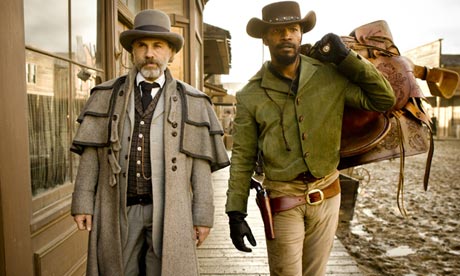
thoughts on the final two Best Picture contenders I’ve seen, Ang Lee’s Life of Pi and Quentin Tarantino’s Django Unchained. These films are lumped together only
incidentally but they do share a handful of prominent features. Both are the latest event movies (if any
movie can really be called that anymore) from modern auteurs who have managed
the increasingly rare feat of both popular and critical acclaim. Both fantasize an alternative history, of sorts:
the one, an encounter with nature on its own turf in the midst of a modernizing
world; the other, revenge for the abject racial subordination that continues to
assert itself a century and a half hence.
And both are basically good but way too damn long, nearly compromised by
excesses unique to their helmsmen – which is where they are, like Lee and
Tarantino, very different.
Life of Pi is 100 minutes of eye-popping wonder augmented by 20 going over what we learned today. Even Yann Martel, scribe of the original novel, has qualified his gushing approval by bemoaning Lee’s unambiguous ending. And indeed it, like the rest, is Lee’s: the maritime exploits of Pi the human and Richard Parker the tiger are absorbing in that just-shy-of-genteel way I’m assured those of his I haven’t seen share with those I have. Even an admirable attempt to épater with a POV piss-take (in both senses of the term) seems well within the well-established PG family film lingua franca. (The funniest parts – involving where the protags got their names – belong entirely to the source material.) That being said, even if a bit sterile, the passages at sea are just about the best evidence yet for the specious argument that digital 3D is truly the next ontological frontier for cinema – or some tunnel-vision idea of it, anyway. (Fittingly, the shipwreck scenes recall another technological milestone in the medium’s history, Carroll Ballard’s The Black Stallion.) But then Lee has to go and bookend these passages with present-day narration that pulls a reverse Big Fish on us and passes it off as metaphysical critique, reconstituting the whole squeaky-clean war-horse as a big steaming pile of horseshit.
Django Unchained deserves
a post of its own, especially in light of Grey’s
Anatomy star Jesse Williams’ impassioned
recent broadside against Tarantino’s neo-grindhouse genre mashup. I hope to address the piece at length at a
later date, but in brief, Williams pounces on the Weinstein’s cherished wunderkind’s lamentable talent for embarrassing public speech,
and questions whether he really deserves so much credit for returning slavery
to the American cultural conversation.
No, he doesn’t; no argument there.
But Williams rehearses the shopworn assumption that portraying atrocity in
the context of pleasure is always already complicit in evil. He goes on to juxtapose Inglourious Basterds with Django
and ask why the former wasn’t as stoked on pain and epithets. That assumes black slavery and the Holocaust
are somehow historically commensurate, which I’d argue they mostly aren’t. (Also, has Williams seen Inglourious’s opening farmhouse massacre?)
But more on that later.
My beef with Django is that,
even more than Death Proof, it
sometimes scans as a fully-funded spoof of Tarantino rather than the man
himself. The breathless carriage of
Christoph Waltz’s overstuffed lines is one instance, Herr Waltz’s otherwise excellent
work notwithstanding. The Mel
Brooks-cribbing proto-Klan sequence is another.
And I wonder how many minutes of exploding squibs could have gotten nixed without anyone really noticing? (I
protest it’s not bloody violence I'm losing my taste for, just the boring
kind.) On the ideological side of
things, I also wonder if Tarantino couldn’t have cut white trash a tiny bit of
slack. Don Johnson’s line about treating
Django “like Jerry” is the only reference made to the underspoken fact that
hillbillies had only a little more to gain from antebellum society than their
black, enchained counterparts. But I
guess asking Quentin Tarantino to flatter my Marxist biases is a little
like asking Ang Lee to scandalize me: in short, an exercise in futility.
Wednesday, February 20, 2013
ARGO/SILVER LININGS PLAYBOOK
These All-American crowd-pleasers don’t have much in common except for their utterly shameless crowdpleasing. Not that I begrudge said pleasing, mind you, but the highest cinematic honor in the land merits at least a little of the kind of cruel scrutiny that ingratiation doesn't often quite bear. So, let us consider one scene from each. In Ben Affleck’s Argo, the last minute discovery of our heroes’ covert escape leads to a chase down the tarmac and cross-cuts between the airline cabin and hysterical guards with potboiler music shaking the subs as the Iranian convoy gets closer and closer until the nose tips, the wheels fold, and finally ah! Sweet, sweet international airspace, and US foreign meddling lives to see another day. But D.W. Griffithizing a civilian extraction is A/V club stuff compared to a scene late in David O. Russell’s Silver Linings Playbook, in which every single character in the cast gathers in one room to work out as methodically as any script doctor can humanly manage how the resolution of each and every plot thread in the film will come to rest on the outcome of an amateur dance competition. This sequence works overtime covering its tracks with seriocomic bluster; about three minutes of sparring Philly accents made me want to cut my fucking ears off. Yet of the two films, I preferred Russell’s, probably due to screwball humor soundly outranking patriotism among my viewing priorities (but possibly due to the delectable Jennifer Lawrence). That's not to say I loved or even particularly liked it, but protagonist Pat's violent response to A Farewell to Arms' feel-bad ending absolves many sins, not least of all the hilarious concept of a man with a heavy Hindi accent observing that "DeSean Jackson is the man." Affleck, for his part - as director and as dashing leading man - plays a farce premise straight, presumably to honor its origins in truth, which begs the question: is a formula thriller’s litany of contrivances really more dignified than satire? All the operative tastefulness leaves over for the funnymen on hand – John Goodman and Alan Arkin, of whom the world is enjoying a welcome resurgence as of late – are hollow laughs flattering received wisdom on what makes Hollywood tick. My colleague Zach Campbell pegs their banter as not so much witty as “witty” (echoes of Richard Jameson’s screed against “style”), and that's really the last of anything that ever needs to be said about it. Its politics meanwhile leave me cold, which is to say neutral, but Kevin B. Lee lays down the law on that eloquently enough. Incidentally, he also thinks Silver Linings deserves Best Picture, "because it's a revealing reflection of the world we live in," which is about as simultaneous a naive fantasy and harrowing omen you're likely to get this Oscars season.
Saturday, February 16, 2013
BEASTS OF THE SOUTHERN WILD
A reshuffling of American cinema’s sacred archetypes over the past decade has dealt us a hand of new superheroes, vampires, and arrested adolescents, so it was really only a matter of time before NOLA delta dwellers Hushpuppy and her hooch-swilling daddy Wink took their posts as the 21st century's Magical Negros. Between handheld camerawork, heaving performances, and heavy-handed mise-en-scène – our six-year-old heroine converses with a paper cutout she’s dressed in her mother’s clothes – there isn’t much room to breathe in this tale of abject Southern poverty. Beasts wants really badly to pull you into the everyday goings-on of its off-the-grid world, but its whimsical neo-primitivism can be a hard sell. Timeout Chicago’s Ben Kenigsberg reads the parable as a “magical-realist apologia for Bush's failings,” and when, following a Katrina-like flood, Hushpuppy’s carefree mixed-race neighbors reject social services as a matter of principle, I’m inclined to agree. But if the first act is dubious and the second infuriating, the final third, an elegant slide into unrestrained fantasy, is sublime. Clueless marketers have already spoiled Hushpuppy’s climactic porcine encounter, but the last twenty minutes dissolve space and time into ambrosia of likeminded reveries. In these moments first-time director Benh Zeitin makes good on the promise of Spike Jonze’s fatally awkward Where the Wild Things Are, and the lead performances, from first-timers Quvenzhané Wallis and Dwight Henry, lend the starry-eyed enterprise more credibility than it really deserves. Everywhere else, though, what materializes is the kind of problematic vision of hardship-as-mythos that only, well, a white guy from Queens could believe in.
Monday, February 11, 2013
AMOUR
In which the titular sensation/concept/process
renews between octogenarian musicians (Jean Trintignant and Emmanuelle Riva) while the fairer rapidly fails. The subject matter of last year’s Palme d’Or would tempt you to believe that in the oeuvre
of Michael Haneke, it’s an evolution, or at least a digression, into something
warm and reasonably generous. But no:
this is a Haneke film from long-take to meticulously composed long-take. Even the close-ups keep their Brechtian
distance, and a specter of menace hovers over each and every frame. Save for a rather brilliant extreme long shot
that obscures the couple in a crowd of concertgoers, Amour takes place entirely in their Parisian flat, and in a way
it’s a spiritual successor to Roman Polanski’s "Apartment Trilogy" (particularly
during Georges’ bait-and-switch nightmare sequence). What separates Amour from Repulsion is
its austerity; that, accompanying a bleak moral vision, serves as Haneke’s distinct authorial
signature. The tenacity of its
application – even the title cards are bare-bones, and non-diegetic music is
nonexistent – suggests that avoiding emotional shortcuts is a matter of
ethical, and not merely formal, concern for the Austrian director. The
idea is that none of lesser cinema’s palliative tactics get between us and Georges
and Anne as Anne is claimed slowly but surely by the ravages of carotid
blockage. But affectlessness is, alas, just
another affect. Haneke might insist that
he’s simply recording Anne’s suffering, but you could just as easily say that
he’s lingering on it, and what results, as Slant’s Calum Marsh aptly observes,
is body horror: Cronenberg’s The Fly with all the decay but none of the sci-fi. Hence the aforementioned
menace.
The
thing is, I’m not sure this isn’t appropriate. If the point of Amour is that getting old is terrifying,
then point very well-taken; Anne’s
struggle to speak after her second stroke and descent, eventually, into
unending agony, is as haptic as it is heartbreaking. I’m willing to believe that’s exactly what
Haneke wants. I’m also willing to
believe his excruciating images are meant to be metonymic: armed with scant
backstory scattered carefully throughout, and our own familiarity with
Trintignant and Riva – the quiet triumph of the initial crowd scene is that our
eyes are drawn immediately to them, without formal encouragement – we’re free
to extrapolate emotionally on our own.
I’m sure this is how Amour
worked for its many admirers, who credit it with a wide breadth of
feeling. Indeed, certain details – how
Georges helping Anne out of her wheelchair or off the toilet is staged as an
awkward slow dance, for example – continue to haunt me, probably specifically
because the film’s enigmatic quality opens them to my projections. But they’re calculated enigmas, Haneke’s high
art method of fleshing out his relentlessness.
As I said, I don’t necessarily find that relentlessness uncalled
for. Nor, however, do I find it terribly
enriching.
Sunday, February 10, 2013
Florida
The view from this tenth floor condo isn't panoramic, but it's close. The south windows face another building, similarly towering, far enough to furnish an illusion of privacy while offering still a disordered grid of backlit vignettes every evening. To the east is the "waterfront view," a misnomer on several levels, the first level a swamp, the second an inlet, and the third, finally, the ocean. A narrow island divides the inlet and the ocean and is itself bisected by a single main thoroughfare, congested at shifting points by mansion expansions so consistent you'd hardly know a tenth of the country was jobless. At neighboring resorts names like the Palladium and the Patrician imagine an aristocratic past with slightly more modesty. It is, in short, a playground for the rich, chaperoned by lurching palms, tended by the local color - people of color, that is. To the west is where they, and the rest of Florida, live, staving off economic desolation one tourist at a time.
That brings us back to the condo. It is here where my parents, like so many, not unreasonably, after working too hard, for too long, rejuvenate in retirement. In that spirit - or something like it - I'm launching another attempt at the blog game, for my benefit and the world's. Provision of actual content shall commence in Chicago, where I begrudgingly return tonight. My first victims will be this year's Oscar contenders. Speaking of conspicuous consumption.
Subscribe to:
Posts (Atom)